
Top 10 Sewing Machines for Beginners: Best Picks & Buying Guide 2026
Choosing the right sewing machine as a beginner is an important step because it directly affects your learning experience, comfort, and long-term progress. A good beginner-friendly machine should be easy to use, durable, and equipped with essential features that simplify basic stitching tasks. In 2026, modern sewing machines are designed with more automation and user-friendly controls, making them ideal for first-time users.
When selecting from the top 10 sewing machines for beginners, it is important to focus on features such as automatic threading, adjustable stitch settings, lightweight design, and smooth operation. These features help reduce frustration and allow beginners to focus on learning techniques rather than struggling with complex machine functions.
Budget and purpose also play a key role in the buying decision. Some machines are designed for simple home repairs and basic sewing projects, while others offer advanced features for creative stitching and small business use. Understanding your needs helps you choose a machine that fits your goals without unnecessary expenses.
Ultimately, the best sewing machine for beginners is one that combines ease of use, reliability, and value for money. A well-chosen machine not only improves learning speed but also builds confidence, allowing beginners to develop their sewing skills efficiently and enjoy the process of creating their own designs.
What is the Best Sewing Machine for Beginners?
Choosing the best sewing machine for beginners is not only about picking a popular brand—it is about understanding how simple, intuitive, and forgiving the machine is for someone who is just starting their sewing journey. Beginners often struggle with threading issues, stitch inconsistency, and machine tension problems, so the right machine should reduce these challenges rather than add complexity.
A good beginner sewing machine should feel like a learning partner rather than a technical obstacle. In my experience, the easiest machines are those that offer clear stitch selection, automatic setup features, and smooth fabric feeding. Brands like Brother, Singer, and Janome are often recommended because they focus on user-friendly designs.
Another important factor is versatility. Beginners usually start with small projects such as pillow covers, hemming clothes, or simple tote bags. A machine that supports basic straight stitches, zigzag stitches, and light decorative options is more than enough at this stage.
Ultimately, the best beginner machine is not the most advanced one—it is the one that helps you learn confidently without frustration.
| Feature | Why It Matters for Beginners | Recommended Level |
|---|---|---|
| Automatic Needle Threader | Reduces setup time and frustration when threading the needle | Highly Recommended |
| Easy Stitch Selection | Helps users switch between stitches quickly | Essential |
| Top-Loading Bobbin System | Makes bobbin insertion easier and reduces jams | Essential |
| Adjustable Stitch Length | Allows better control over different sewing projects | Recommended |
| Adjustable Stitch Width | Improves stitch customization and creativity | Recommended |
| Lightweight Design | Easier to move, store, and transport | Recommended |
| Built-in Stitches | Supports different sewing techniques and projects | 10–30 Stitches |
| Free Arm Capability | Useful for sleeves, cuffs, and circular sewing | Recommended |
| Speed Control | Helps beginners sew safely and accurately | Highly Recommended |
| Automatic Buttonhole Feature | Simplifies garment-making projects | Recommended |
Key Features Beginners Should Look For
When selecting a sewing machine, beginners should focus on features that make the learning process simple and stress-free. One of the most important features is an automatic needle threader, which helps save time and reduces eye strain, especially for those who are new to sewing. Simple stitch selection is also essential, preferably through a clearly labeled dial or an easy digital interface that allows users to switch between stitches without confusion.
A reliable bobbin system is another crucial factor. Top-loading bobbins are generally more beginner-friendly because they are visible, easier to insert, and less likely to cause thread jams. Adjustable stitch length and width are also helpful because they allow beginners to experiment with different stitching styles while learning without needing advanced technical knowledge.
Ease of maintenance should not be overlooked when choosing a sewing machine. Machines that are easy to clean, oil, and maintain help beginners avoid unnecessary frustration and focus more on skill development. Lightweight designs are also beneficial because they make the machine easier to move, store, and set up in different spaces.
Why Beginner-Friendly Machines Matter
Beginner-friendly sewing machines play a very important role in building confidence and consistency in new learners. If a machine is too complex, beginners may feel overwhelmed and lose interest before developing basic sewing skills. A simple and intuitive machine allows users to focus on learning fabric handling, straight stitching, and basic project creation without technical distractions.
These machines are specifically designed to minimize common sewing problems such as thread bunching, skipped stitches, or tension issues. Many beginner models also include preset settings and safety features that help prevent incorrect adjustments, making the learning process smoother and more enjoyable.
A positive learning experience is essential in sewing because skill development depends heavily on repetition and practice. When beginners find the process enjoyable and manageable, they are more likely to practice regularly, improve their techniques, and build long-term confidence in their sewing abilities.
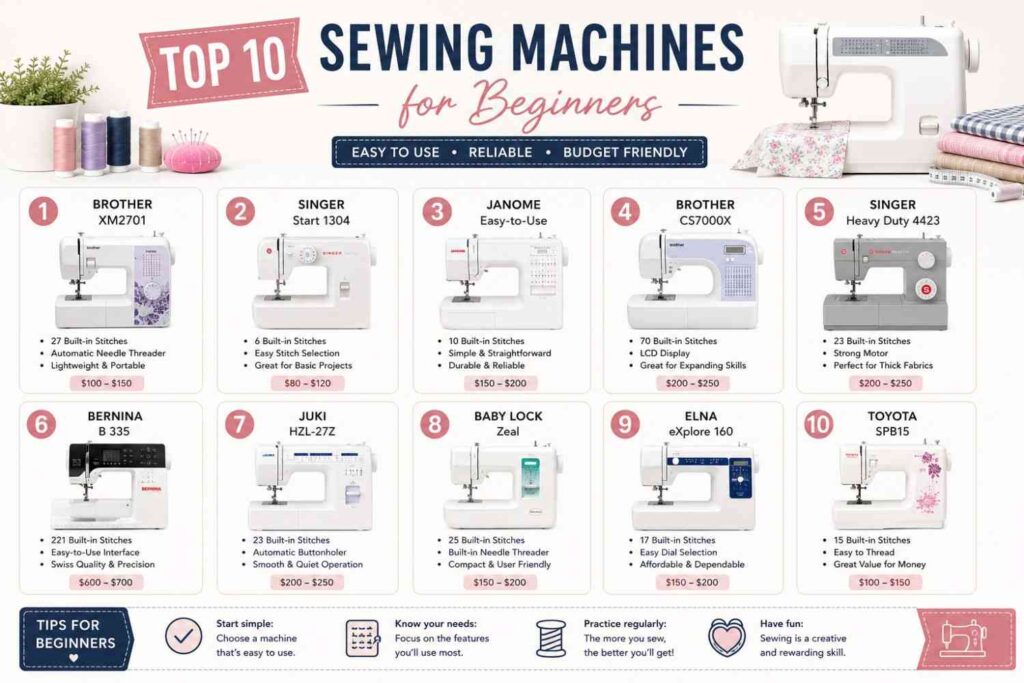
Top 10 Sewing Machines for Beginners Overview
The Top 10 Sewing Machines for Beginners include a mix of mechanical and computerized models designed to suit different budgets and learning preferences. Some users prefer simplicity, while others want modern features that automate most settings.
In this list, we compare machines based on ease of use, durability, stitch variety, and overall value. Each model serves a slightly different purpose, so beginners can choose according to their goals—whether it is casual home sewing, fashion projects, or fabric repairs.
Brands like Brother, Singer, and Janome dominate this category because they offer consistent performance and strong after-sales support.
This section helps you quickly understand which machines stand out and why they are recommended for first-time users.
Comparison Insights
When comparing beginner sewing machines, one of the biggest differences is between mechanical and computerized models. Mechanical machines are controlled manually and are often more durable and affordable. Computerized machines, on the other hand, offer automated stitch settings, LCD screens, and preset programs that simplify the sewing process.
Beginners who prefer hands-on learning often choose mechanical machines because they help them understand the fundamentals of stitching. However, those who want convenience and speed may prefer computerized options.
Another key insight is stitch variety. While beginners do not need hundreds of stitches, having at least 10–20 built-in options provides flexibility for creative growth.
Best Overall Pick Summary
The Brother CS7000X consistently ranks as one of the best overall beginner machines due to its balance of features and simplicity. It offers a wide stitch selection, quilting capabilities, and easy digital controls.
What makes it stand out is not just the features but how intuitively they are arranged. Beginners can start sewing within minutes without reading complicated manuals. This makes it ideal for users who want long-term usability without feeling overwhelmed.
Best Budget Sewing Machines for Beginners
Budget sewing machines are ideal for beginners who want to learn without making a large financial commitment. These machines typically focus on essential functions such as straight stitching, zigzag stitching, and basic fabric handling.
Even though they are affordable, many budget models still offer excellent durability and reliability. The goal is not advanced functionality but smooth learning. These machines are perfect for students, hobbyists, and anyone exploring sewing for the first time.
Most budget-friendly options come from trusted manufacturers like Singer, Brother, and Janome, ensuring consistent quality.
These machines allow beginners to practice basic techniques without worrying about complex configurations or expensive repairs.
Singer Start 1304
The Singer Start 1304 is designed specifically for absolute beginners. It features preset stitch patterns that eliminate confusion during setup. Users simply select a stitch and begin sewing.
This model is extremely lightweight, making it easy to move and store. It is particularly useful for small household projects such as repairs, hemming, or simple crafts.
While it does not include advanced digital features, its simplicity is its greatest strength. Beginners can focus entirely on learning stitching techniques without distractions.
Brother XM2701
The Brother XM2701 is a compact and versatile machine. It includes multiple built-in stitches, automatic needle threading, and a lightweight design.
What makes it popular is its balance between affordability and functionality. It allows beginners to experiment with decorative stitches while still maintaining simple controls.
It is also suitable for small home sewing projects and light fabrics, making it a practical long-term beginner option.
Janome 2212
The Janome 2212 is a mechanical sewing machine known for durability and stability. This model is built for users who prefer manual control.
It includes a simple dial system for stitch selection, making it easy to understand even for first-time users. Its strong build quality ensures long-term reliability.
This machine is ideal for learners who want a traditional sewing experience without digital complexity.
Best Mid-Range Sewing Machines
Mid-range sewing machines are an excellent choice for beginners who have mastered the basics and are ready to take on more creative and demanding projects. These machines typically offer a balance between affordability and advanced functionality, providing features that are not usually available on entry-level models. They often include computerized controls, a larger variety of stitches, automatic settings, and improved fabric handling capabilities.
For users interested in garment construction, quilting, home décor projects, or decorative stitching, mid-range sewing machines provide the flexibility needed to expand skills without investing in expensive professional equipment. They are designed to make sewing more efficient while still remaining accessible to learners who are progressing beyond beginner-level projects.
Brother CS7000X
The Brother CS7000X is one of the most popular computerized sewing machines for advancing beginners because it combines ease of use with a wide range of creative features. It includes numerous built-in stitch patterns, quilting functions, and a clear LCD display that allows users to navigate settings quickly and easily.
Its automatic features, including needle threading and stitch selection, help reduce setup time and improve sewing accuracy. Beginners can experiment with decorative stitches, quilting techniques, and garment construction without feeling overwhelmed by complicated controls.
The machine is also known for its versatility across different fabric types, making it suitable for everything from lightweight cotton to thicker quilting materials. This flexibility makes it a strong long-term investment for users looking to develop their sewing skills.
Janome MOD-19
The Janome MOD-19 is designed for creative sewists who want a machine that combines reliability with decorative stitching options. It offers a practical selection of utility and decorative stitches, allowing beginners to explore more advanced sewing techniques while maintaining ease of operation.
One of the standout qualities of this machine is its smooth fabric handling. The feed system moves fabric consistently through the machine, helping produce neat, even stitches and reducing common beginner frustrations. This makes it particularly useful for clothing projects, crafts, and home décor applications.
Its user-friendly design and durable construction make it a dependable choice for those who want a machine that can support their growth from beginner to intermediate sewing levels.
Brother XR9550
The Brother XR9550 is a feature-rich computerized sewing machine that offers an extensive selection of built-in stitches and advanced convenience features. It is particularly well-suited for beginners who are transitioning into more complex sewing projects and want additional creative options.
Its digital interface simplifies stitch selection and machine settings, making advanced features easier to understand and use. Beginners can gradually learn decorative stitching, buttonholes, quilting techniques, and other specialized functions without needing extensive technical knowledge.
The combination of computerized controls, automatic functions, and stitch variety makes the XR9550 a highly versatile machine. It provides room for skill development while remaining approachable for users who are still building confidence in their sewing abilities.
Heavy-Duty Sewing Machines for Beginners
Heavy-duty sewing machines are specifically designed for users who plan to work with thicker fabrics and more demanding sewing projects. Unlike standard machines, they feature stronger motors, reinforced internal components, and durable metal frames that allow them to sew through multiple layers of fabric with greater ease and consistency.
These machines are ideal for projects involving denim, canvas, upholstery fabric, leather alternatives, curtains, tote bags, and other heavy materials. While they are more powerful than standard beginner machines, many modern heavy-duty models are designed with simple controls and user-friendly features that make them accessible to new sewists.
For beginners who expect to work on durable fabrics or want a machine that can grow with their skills, a heavy-duty model can be a smart long-term investment. The combination of power, durability, and versatility makes these machines suitable for both everyday sewing and more advanced creative projects.
Singer Heavy Duty 4423
The Singer Heavy Duty 4423 is one of the most popular heavy-duty sewing machines for beginners because it combines power with ease of use. Equipped with a strong motor, it can sew through thick fabrics such as denim, canvas, and multiple fabric layers much more efficiently than many standard entry-level machines.
Despite its impressive performance, the machine remains beginner-friendly thanks to its simple stitch selection system and straightforward controls. New users can quickly learn the basics without feeling overwhelmed by complicated settings or computerized features.
Its durable metal frame helps maintain stability during sewing, reducing vibration and improving stitch consistency. This durability makes it suitable for frequent use and ensures that the machine can handle a variety of sewing projects over many years.
Juki HZL-29Z
The Juki HZL-29Z is known for delivering reliable performance and exceptional durability in a compact design. Juki has a strong reputation in the sewing industry, and this model reflects the brand’s focus on smooth operation and long-lasting quality.
One of its standout features is its ability to produce clean, consistent stitches across different fabric types. Whether working with lightweight materials or heavier fabrics, the machine maintains reliable stitch quality and fabric control.
Its sturdy construction and simple operation make it a good choice for beginners who want a dependable machine that can support skill development while also handling more challenging projects as experience grows.
Singer 3337
The Singer 3337 is a versatile sewing machine that combines user-friendly features with dependable everyday performance. It is well-suited for beginners who need a machine capable of handling regular sewing tasks while still offering enough flexibility for creative projects.
The machine provides simple controls and a selection of built-in stitches that allow new users to learn fundamental sewing techniques without unnecessary complexity. Its intuitive design helps reduce the learning curve and encourages confidence during practice.
While it may not be as powerful as some dedicated heavy-duty models, the Singer 3337 delivers reliable performance for a wide range of household sewing projects. Its balance of durability, ease of use, and affordability makes it a practical option for beginners seeking a dependable sewing machine.
Premium Beginner-Friendly Sewing Machines
Premium beginner sewing machines are designed for users who want a more advanced sewing experience without sacrificing ease of use. These machines combine beginner-friendly operation with higher-end features that improve convenience, precision, and creative flexibility. While they cost more than basic entry-level models, they often provide better durability, smoother performance, and features that remain useful as sewing skills develop.
Many premium beginner machines include automatic needle threading, advanced stitch selection systems, digital displays, speed control options, and built-in stitch memory functions. These features reduce manual adjustments and help beginners achieve professional-looking results with less effort. They also make learning new techniques easier by simplifying many of the tasks that traditionally require experience.
For users who plan to sew regularly or pursue more advanced projects in the future, a premium beginner machine can be a worthwhile investment. Instead of upgrading after a short period, these machines provide room for growth while remaining approachable for those who are still learning the fundamentals of sewing.
Bernette B33
The Bernette B33 is a beginner-focused sewing machine that emphasizes simplicity, reliability, and quality stitching performance. Designed by a brand known for precision and durability, this machine offers a straightforward sewing experience without unnecessary complexity.
Its easy-to-use controls allow beginners to focus on learning essential sewing skills such as threading, stitch control, and fabric handling. Despite its simplicity, the machine delivers consistent stitch quality and smooth operation, helping users achieve clean and professional-looking results.
The durable construction of the Bernette B33 also makes it a long-term option for beginners who want a dependable machine that can support a wide variety of sewing projects. Its combination of ease of use and reliable performance makes it a strong choice for new sewists seeking quality and simplicity.
Brother XR9550 Advanced Features
The Brother XR9550 stands out among beginner-friendly sewing machines because of its computerized controls and extensive range of built-in features. It is particularly appealing to creative beginners who want to explore decorative stitching, garment construction, quilting, and other advanced sewing techniques.
Its digital interface simplifies stitch selection and machine adjustments, allowing users to experiment with different sewing styles without manually changing complex settings. The machine offers a large selection of built-in stitches, automatic functions, and customizable options that encourage creativity while maintaining ease of operation.
As sewing skills improve, the advanced capabilities of the XR9550 continue to provide value. Beginners can start with basic projects and gradually explore more sophisticated techniques, making this machine an excellent option for those who want a feature-rich model that supports long-term skill development.
How to Choose the Right Sewing Machine
Choosing the right sewing machine is one of the most important decisions for any beginner because it directly affects the learning experience, project quality, and long-term satisfaction. A machine that matches your needs can make sewing enjoyable and productive, while the wrong choice may lead to frustration and slow progress. Before purchasing, it is important to consider your sewing goals, the types of fabrics you plan to use, and whether you intend to sew occasionally or pursue sewing as a long-term hobby.
A well-chosen sewing machine should balance ease of use, durability, and functionality. Beginners often benefit from machines that offer essential features without overwhelming complexity. Understanding the key factors that influence performance can help you select a machine that supports both current needs and future skill development.
| Sewing Machine Type | Best For | Advantages | Potential Drawbacks |
|---|---|---|---|
| Mechanical Sewing Machine | Absolute beginners | Affordable, durable, easy maintenance | Fewer automated features |
| Computerized Sewing Machine | Beginners wanting convenience | Automatic settings, more stitch options | Higher cost |
| Heavy-Duty Sewing Machine | Thick fabrics like denim and canvas | Strong motor and durability | Heavier machine weight |
| Portable Sewing Machine | Small projects and travel use | Lightweight and compact | Limited power and features |
| Quilting Sewing Machine | Quilting and creative projects | Large workspace and stitch variety | More expensive |
| Basic Home Sewing Machine | Everyday repairs and beginner projects | Simple operation and affordability | Limited advanced functions |
Stitch Types
The variety of stitches available on a sewing machine can significantly affect its versatility. However, beginners do not need hundreds of decorative stitches to start sewing successfully. The most important stitches for learning are the straight stitch and zigzag stitch, as these handle the majority of basic sewing tasks and repairs.
As skills improve, additional stitches such as stretch stitches, buttonhole functions, and decorative patterns can become useful for more advanced projects. Choosing a machine that offers a good balance between essential and creative stitch options provides flexibility without adding unnecessary complexity.
Motor Power
Motor power plays a major role in determining how effectively a sewing machine handles different fabric types. Machines with stronger motors can sew through thick materials such as denim, canvas, upholstery fabrics, and multiple fabric layers with greater ease and consistency.
For beginners who plan to work primarily with lightweight fabrics, a standard motor is usually sufficient. However, if future projects may include heavier materials, selecting a machine with stronger motor performance can prevent limitations and reduce the need for an early upgrade.
Accessories and Features
Included accessories can greatly enhance the usability and versatility of a sewing machine. Common accessories such as extra presser feet, bobbins, seam guides, and needle sets allow beginners to experiment with different techniques and projects more easily.
Additional features such as automatic needle threading, adjustable stitch settings, free-arm sewing, and easy bobbin systems can simplify the sewing process and reduce common frustrations. A machine that includes useful accessories and beginner-friendly features often provides better value and a smoother learning experience, making it easier to build confidence and develop sewing skills over time.
Maintenance Tips for Sewing Machines
Proper maintenance is essential for keeping a sewing machine running smoothly and extending its lifespan. Even the best sewing machines can experience performance issues if they are not cleaned and maintained regularly. Beginners often overlook maintenance, but simple care routines can prevent many common sewing problems and ensure consistent stitch quality.
Regular maintenance also improves reliability and reduces the likelihood of thread jams, tension problems, and mechanical wear. By spending a few minutes caring for your machine after sewing sessions, you can avoid costly repairs and maintain optimal performance for years.
Cleaning
Cleaning is one of the most important maintenance tasks for any sewing machine. During sewing, lint, fabric fibers, and dust naturally accumulate around the bobbin area, feed dogs, and internal components. Over time, this buildup can interfere with machine operation and cause thread jams or uneven stitching.
Using a small cleaning brush to remove lint after major projects helps keep the machine functioning properly. It is also a good idea to wipe down the exterior and remove loose debris from accessible areas according to the manufacturer’s instructions. Consistent cleaning improves stitch quality and helps prevent unnecessary mechanical issues.
Oiling
Some sewing machines require periodic oiling to keep moving parts operating smoothly and reduce internal friction. Proper lubrication helps prevent excessive wear and ensures that the machine runs quietly and efficiently.
However, not all modern machines require regular oiling, so it is important to consult the user manual before applying any lubricant. For machines that do require oil, using only manufacturer-recommended sewing machine oil is essential. Correct lubrication helps maintain smooth mechanical performance and can significantly extend the life of the machine.
Troubleshooting
Understanding basic troubleshooting can help beginners quickly solve common sewing machine problems without professional assistance. Issues such as skipped stitches, thread bunching, broken threads, or uneven tension are often caused by simple setup errors rather than serious mechanical faults.
Checking the needle condition, rethreading the machine, verifying bobbin placement, and ensuring correct tension settings can resolve many common problems. Replacing a dull or bent needle is often one of the easiest and most effective solutions when stitch quality begins to decline. Learning these basic troubleshooting techniques helps reduce frustration and keeps sewing projects running smoothly.
Frequently Asked Questions
Frequently Asked Questions (FAQs) are an important part of any fitness guide because they provide quick, clear answers to the most common doubts people have. Instead of going through long explanations, readers can use FAQs to understand key concepts in a simple and direct way.
In fitness, people often struggle with similar concerns such as workout routines, diet plans, progress timelines, and motivation. FAQs help simplify these topics and make it easier to apply practical steps in real life.
They also serve as a quick summary of the most important points covered in a guide. By reviewing FAQs, readers can reinforce their understanding and make better decisions about their fitness journey.
What is the best sewing machine for beginners?
The best sewing machine for beginners is one that combines ease of use, reliability, and essential features without being overly complicated. Popular beginner-friendly models such as the Brother CS7000X and Singer Start 1304 are frequently recommended because they offer intuitive controls, dependable performance, and a smooth learning experience.
These machines help new sewists focus on developing basic skills rather than troubleshooting technical issues. Features such as simple stitch selection, easy threading systems, and user-friendly designs make them excellent choices for those just starting their sewing journey.
Is a computerized sewing machine better for beginners?
Computerized sewing machines can be very helpful for beginners because they automate many settings and reduce the chances of user error. Features such as digital stitch selection, automatic buttonholes, and built-in stitch recommendations make sewing more convenient and less intimidating.
However, mechanical sewing machines also have advantages. They help beginners understand the fundamentals of stitch control, tension adjustment, and machine operation. The best choice depends on personal preference, budget, and how much automation a beginner wants during the learning process.
How much should a beginner spend on a sewing machine?
Most beginners can find a quality sewing machine within the $100 to $300 price range. This budget typically provides access to reliable machines that include essential features such as multiple stitch options, adjustable settings, and durable construction.
While very inexpensive machines may be appealing, they sometimes lack the reliability and functionality needed for long-term use. Investing in a well-reviewed machine within a moderate price range often provides better value and a more enjoyable sewing experience.
Which sewing machine is easiest to use at home?
Lightweight and user-friendly machines such as the Brother XM2701 and Singer Start 1304 are often considered among the easiest sewing machines for home use. They feature straightforward controls, simple threading systems, and compact designs that are easy to store and transport.
These machines are particularly suitable for beginners because they focus on essential functions without overwhelming users with advanced settings. Their simplicity helps build confidence while still allowing for a wide range of basic sewing projects.
Can beginners use heavy-duty sewing machines?
Yes, beginners can absolutely use heavy-duty sewing machines, especially if they plan to work with thick fabrics such as denim, canvas, or upholstery materials. Models like the Singer Heavy Duty 4423 are specifically designed to provide extra power while remaining easy to operate.
Many heavy-duty machines include simple controls and beginner-friendly features despite their stronger motors. This allows new sewists to learn basic techniques while having the capability to handle more demanding projects as their skills improve.
What features are most important for beginners?
The most important features for beginners are those that simplify operation and reduce common frustrations. Automatic needle threading, easy bobbin systems, adjustable stitch settings, and simple stitch selection controls can make learning much easier and more enjoyable.
Additional features such as clear instruction guides, free-arm sewing capability, and built-in buttonhole functions can also enhance the sewing experience. Ultimately, the best beginner sewing machine is one that balances simplicity, reliability, and enough versatility to support future skill development.
Conclusion
The Top 10 Sewing Machines for Beginners offer a wide variety of choices to suit different budgets, project types, and learning preferences. Whether you are looking for a simple mechanical machine for basic repairs or a computerized model with advanced features, there are beginner-friendly options available from trusted brands such as Brother Industries, Singer, and Janome. These brands have built strong reputations for reliability, ease of use, and long-term performance, making them excellent starting points for new sewists.
Choosing the right machine ultimately depends on your sewing goals, the types of fabrics you plan to work with, and the features that matter most to you. Beginner-friendly options with simple controls, automatic threading systems, and easy bobbin setups can significantly reduce frustration and make the learning process more enjoyable. Investing in a machine that matches your needs helps create a smoother path toward developing sewing skills and completing projects successfully.
It is also important to remember that the most expensive machine is not always the best choice for a beginner. Starting with a machine that offers essential features and dependable performance allows you to focus on learning core techniques such as stitching, fabric handling, and machine operation. As your confidence and experience grow, you can gradually explore more advanced features and creative sewing possibilities.
The key to success is to start simple, practice consistently, and choose a machine that encourages learning rather than creating unnecessary complexity. With the right sewing machine and a willingness to learn, beginners can quickly build confidence, develop valuable skills, and enjoy the rewarding process of creating their own handmade projects.
Comments are closed, but trackbacks and pingbacks are open.