
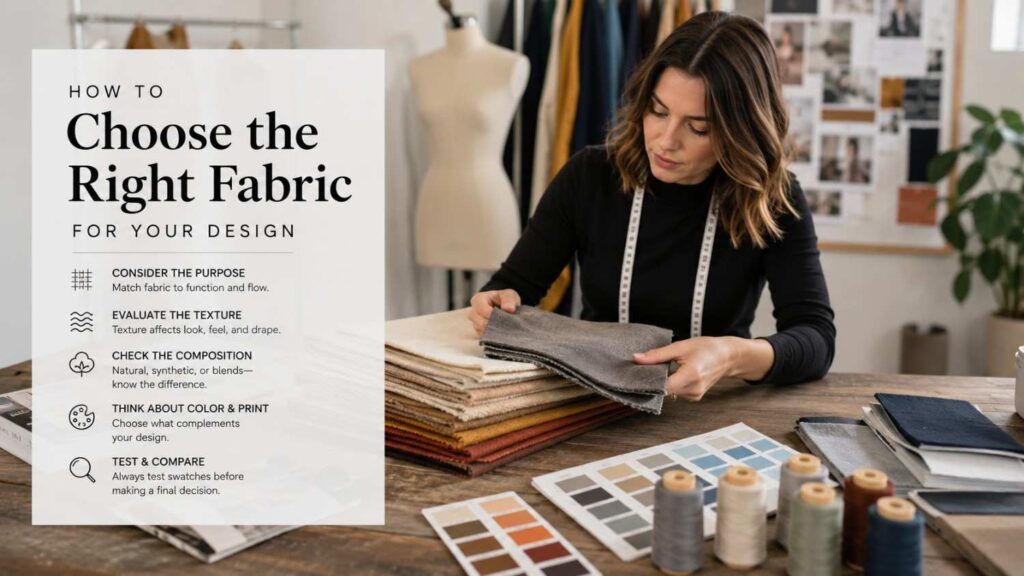
How to Choose the Right Fabric for Your Design
How to Choose the Right Fabric for Your Design is one of the most important decisions in fashion, product development, interiors, accessories, and textile-based branding. Fabric influences almost every part of the final result. It affects the shape of the design, the way it moves, how comfortable it feels, how long it lasts, how easy it is to maintain, and how professional the finished product appears.
Many beginners start by choosing fabric based on color, print, or trend. Those details matter, but they should never be the first decision. A beautiful print on the wrong fabric can still fail if the material is too stiff, too weak, too transparent, too heavy, or difficult to sew. A successful design starts with a balance between creativity and function.
Fabric selection should be treated as a technical and creative process. Cornell University’s apparel sourcing guidance explains that fiber content contributes to a fabric’s appearance, comfort, durability, cost, and care characteristics, while fabric construction also affects aesthetic, functional, and cost qualities. This means a designer must consider both what the fabric is made of and how it is constructed.
This guide explains how to evaluate fabric in a practical, professional way so your design can move from concept to finished product with fewer mistakes.
Start With the Purpose of the Design
Before comparing fabric types, colors, patterns, or suppliers, define the purpose of the design. This step gives direction to every decision that follows. A fabric that works beautifully for eveningwear may be completely unsuitable for activewear. A textile that looks elegant in a showroom may not survive repeated washing, sunlight exposure, or daily friction. Starting with purpose helps you avoid choosing a material only because it looks attractive at first glance.
The purpose of the design includes the product category, user needs, expected performance, environment, care method, and production plan. For clothing, you need to think about movement, fit, comfort, climate, skin contact, and washing frequency. For home décor, you need to consider sunlight, cleaning, abrasion, weight, and how the fabric hangs. For accessories, you may need more structure, seam strength, and resistance to wear.
This section is the foundation of How to Choose the Right Fabric for Your Design because it connects the creative idea to real-world use. Once you understand what the fabric must do, it becomes easier to eliminate unsuitable options and focus on materials that support the design goal. A clear purpose also helps when speaking with suppliers, pattern makers, sample makers, manufacturers, or clients because everyone understands the performance expectations from the beginning.
What will the fabric be used for?
The first question is simple but powerful: what is the final product? A summer blouse, winter coat, yoga top, hotel curtain, tote bag, sofa cover, and bridal gown all require different fabric behavior. The fabric must match the product’s function, not just its visual style. For example, a fabric used for fitted trousers should usually have enough strength, recovery, and opacity to handle movement and sitting. A fabric used for a soft blouse may need breathability, fluid drape, and a comfortable hand feel against the skin.
You should also think about where and how the product will be used. A garment worn in a warm climate may need lightweight, breathable fabric. A uniform may need durability and easy-care performance. A decorative pillow may prioritize texture and appearance, while an outdoor cushion may need resistance to moisture and sunlight. When the end use is clear, fabric selection becomes more logical and less overwhelming. The right fabric should help the design perform naturally instead of forcing the product to behave in a way the material cannot support.
Who is the target user?
The target user strongly affects textile selection. A fabric may be technically suitable for a design but wrong for the person who will use it. Children’s clothing, for example, usually needs soft touch, washability, durability, and comfort. Premium eveningwear may prioritize elegance, luxury texture, and graceful movement. Workwear needs strength, easy maintenance, and reliable performance after repeated use. Activewear often requires stretch, recovery, breathability, and moisture management.
You also need to consider the user’s lifestyle and expectations. A customer who wants everyday convenience may avoid dry-clean-only garments. A professional buyer may ask for test results, care information, and labeling details before approving a fabric. In the United States, most textile and wool products are required to carry labels showing fiber content, country of origin, and the identity of the manufacturer or another responsible business. For apparel and related goods, care instructions are also a major part of responsible product planning. When you understand the user, you can choose fabric that supports comfort, confidence, maintenance, and long-term satisfaction.
Compare Fiber Content and Fabric Types
After defining the design purpose, the next step is to compare fiber content and fabric types. Fiber content tells you what the fabric is made from, while fabric construction explains how the fibers or yarns are formed into cloth. Both factors influence the way the fabric looks, feels, performs, and behaves during production. This is why saying “cotton,” “silk,” or “polyester” is not enough on its own. The same fiber can produce many different fabrics depending on yarn, weave, knit structure, finish, thickness, and blending.
For example, cotton can become crisp poplin, heavy denim, soft jersey, sturdy canvas, or absorbent terry cloth. Polyester can appear as chiffon, satin, fleece, mesh, suiting, or performance knit. Each version behaves differently, even if the fiber name is the same. This is one reason fabric selection should never rely only on a broad fabric category.
When comparing fabric for fashion design or product design, look at the full material profile. Check fiber content, fabric construction, weight, width, stretch, opacity, finish, care method, and supplier specifications. Cornell’s sourcing guidance explains that fiber content can be natural, man-made from plant sources, or synthetic from petroleum-based sources, and that it contributes to appearance, comfort, durability, cost, and care. Understanding these categories helps beginners make better choices and helps advanced designers communicate more precisely with mills, suppliers, and production teams.
Natural, man-made, and synthetic fabrics
Natural fabrics come from plant or animal fibers. Common examples include cotton, linen, wool, silk, alpaca, and similar specialty fibers. These materials are often chosen for comfort, breathability, texture, and premium feel. Cotton is widely used for everyday clothing, shirts, jersey, denim, and home textiles. Linen is known for crisp texture and warm-weather appeal. Wool provides warmth, resilience, and structure. Silk offers softness, sheen, and elegant drape.
Man-made cellulosic fibers, such as rayon, acetate, and lyocell, are produced from plant-based cellulose through manufacturing processes. These fabrics are often selected for softness, drape, and absorbency. Synthetic fibers include polyester, nylon, acrylic, olefin, and spandex. They are commonly used when strength, wrinkle resistance, stretch, durability, or easy care is important. University of Georgia Extension notes that polyester fabrics are generally easy to care for and wrinkle resistant, while rayon is absorbent but can wrinkle and lose strength when wet. These differences show why fiber choice should match the design’s practical needs, not just its appearance.
| Fabric Category | Common Examples | Key Characteristics | Best Used For | Main Consideration |
|---|---|---|---|---|
| Natural Fabrics | Cotton, Linen, Wool, Silk | Breathable, comfortable, natural feel | Everyday clothing, luxury garments, home textiles | May wrinkle or require extra care |
| Man-Made Cellulosic Fabrics | Rayon, Lyocell, Acetate | Soft texture, fluid drape, breathable | Dresses, blouses, lightweight apparel | Some fibers lose strength when wet |
| Synthetic Fabrics | Polyester, Nylon, Acrylic, Spandex | Durable, wrinkle-resistant, easy care | Activewear, outerwear, performance clothing | Lower breathability than many natural fibers |
| Fabric Blends | Cotton-Polyester, Wool Blends | Combines multiple performance benefits | Casual wear, uniforms, fashion garments | Performance depends on blend ratio |
Woven, knit, and nonwoven construction
Fabric construction is just as important as fiber content. The George Washington University Textile Museum explains that textiles can be created through structures such as weaving, looping, and fusing fibers. Woven textiles are made by interlacing warp and weft yarns, while knitted textiles are made through looped yarn structures. This construction difference affects stability, stretch, movement, and the way a product fits or hangs.
Woven fabric is usually more stable than knit fabric, making it suitable for shirts, trousers, jackets, skirts, structured dresses, curtains, upholstery, and bags. It can hold seams, pleats, collars, waistbands, and tailored shapes more effectively. Knit fabric usually has more stretch and flexibility, which makes it useful for T-shirts, leggings, sweaters, underwear, activewear, and fitted garments. Nonwoven fabrics are made by bonding or fusing fibers instead of weaving or knitting them. They are often used in interfacings, filters, padding, disposable products, craft materials, and technical applications. When you choose between woven, knit, and nonwoven fabric, think about movement, structure, seam behavior, and user comfort.
Match Fabric Weight, Drape, and Structure
Fabric weight, drape, and structure determine how the design looks in real life. A sketch may suggest shape and movement, but fabric decides whether that vision can actually happen. A lightweight fabric may float and move beautifully, but it may not hold a sharp silhouette. A heavy fabric may create strong structure, but it may feel bulky or uncomfortable if used for a design that needs softness. This is why fabric testing is essential before production.
Fabric weight refers to how heavy or light a textile is. Drape describes how the fabric falls, folds, and moves. Structure describes the fabric’s ability to hold shape, support seams, and create form. These three qualities work together. A fabric with high structure and low drape may be ideal for a sculptural jacket or bag. A fabric with soft drape and low structure may be better for blouses, scarves, loose dresses, and relaxed garments.
This section is especially important for designers who want to understand how fabric weight affects drape. The wrong weight can change the entire silhouette. A pattern designed for crisp cotton poplin may look limp in rayon challis. A dress designed for soft chiffon may look bulky in canvas. When learning How to Choose the Right Fabric for Your Design, always hold, fold, hang, and move the fabric before deciding. A flat swatch on a table does not tell the full story.
How fabric weight affects the final result
Fabric weight has a major impact on the finished design. Lighter fabrics are often used for shirts, blouses, linings, scarves, summer garments, and soft layering pieces. Medium-weight fabrics are common for dresses, trousers, uniforms, casual jackets, and many home décor products. Heavier fabrics are often used for coats, structured skirts, upholstery, bags, denim products, canvas items, and outerwear. The best choice depends on how much body, warmth, durability, and movement the design requires.
Cornell’s apparel sourcing material explains that fabric weight is influenced by yarn diameter and the number of yarns per inch in the knit or weave. This means weight is not random; it is connected to how the textile is constructed. A heavier fabric may provide better coverage and durability, but it may also affect comfort and sewing difficulty. A lighter fabric may create elegant movement but may require lining, careful seam finishing, or special handling. Designers should compare weight with the garment or product purpose. The goal is not to choose the heaviest or lightest fabric, but the most suitable fabric for the desired result.
| Design Goal | Better Fabric Direction | Why It Works |
|---|---|---|
| Flowing dress | Chiffon, georgette, rayon, silk-like fabrics | Soft movement and fluid drape |
| Tailored blazer | Wool blends, twill, suiting, structured woven fabric | Holds shape, seams, and tailoring details |
| Casual T-shirt | Cotton jersey, cotton blends, knit fabric | Comfortable, flexible, and easy to wear |
| Activewear | Polyester/spandex, nylon/spandex | Stretch, recovery, and performance support |
| Tote bag | Canvas, denim, duck cloth | Strength, body, and durability |
| Curtains | Linen, cotton blends, velvet, sheers | Supports different levels of light control and drape |
How to judge drape and hand feel
Drape and hand feel are best judged physically. Drape shows how the fabric falls when it is hanging or moving. Hand feel describes how the fabric feels when touched, gathered, rubbed, or pressed between your fingers. A fabric may look good in a photo but feel stiff, slippery, scratchy, thin, bulky, or unstable in person. This is why professional designers usually order swatches before buying larger quantities.
To test drape, hold the fabric from one corner and let it fall naturally. Watch whether it collapses softly, forms rounded folds, hangs straight, or stands away from the body. Then gather the swatch in your hand. Notice whether it springs back, creases, stretches, clings, or wrinkles. For structured garments, look for fabrics with body and stability. For fluid silhouettes, look for fabrics that fold and move gracefully. Hand feel also affects customer experience. A fabric used close to the skin should feel comfortable, while a fabric used for bags or interiors may need firmness more than softness. Good fabric selection balances visual movement with touch and usability.
Check Performance, Quality, and Care
A fabric must do more than look good when it is new. It must perform during cutting, sewing, fitting, pressing, wearing, washing, storing, shipping, and repeated use. This is where quality evaluation becomes essential. A material that looks impressive at first can become a problem if it shrinks, pills, fades, stretches out, frays excessively, loses shape, or feels uncomfortable after use. For professional design work, fabric performance should be checked before the fabric is approved.
Performance requirements vary by product. A fashion sample for a photoshoot may have different needs from a garment that will be sold to customers. A sofa fabric needs resistance to abrasion and cleaning stress. A uniform needs consistency after repeated laundering. Activewear needs stretch recovery and moisture performance. Babywear and children’s garments need comfort, safety-conscious choices, and practical care. These differences make fabric testing an important part of product development.
AATCC, a textile standards organization, develops test methods used by the textile industry for product quality. Its standards cover areas such as colorfastness, dimensional change, moisture management, and other textile performance properties. Designers may not need laboratory testing for every personal project, but brands, manufacturers, and commercial sellers should take testing seriously. Quality problems are easier and cheaper to solve before production than after customers receive the final product.
Test durability, shrinkage, and colorfastness
Durability, shrinkage, and colorfastness are three of the most important fabric performance checks. Durability shows whether the fabric can handle use, friction, washing, stretching, and handling. Shrinkage shows whether the fabric changes size after washing, steaming, or pressing. Colorfastness shows whether the color resists fading, bleeding, crocking, or transfer during use and cleaning. If these areas are ignored, the finished product may fail quickly even if the design looks beautiful.
For small projects, you can run simple swatch tests at home. Wash and dry the sample using the intended care method. Measure it before and after washing to check shrinkage. Rub the colored fabric with a clean white cloth to see if dye transfers. Hold it up to light to check opacity. Stretch it gently and see whether it returns to shape. Press it with the expected iron temperature and observe shine, melting, distortion, or texture change. For commercial products, request formal test reports from suppliers or independent labs. AATCC test methods are commonly used in the textile industry for evaluating properties such as dimensional change, colorfastness, and moisture management.
Review labeling and care requirements
Care instructions are not a minor detail. They affect customer satisfaction, returns, reviews, legal compliance, and long-term product value. A fabric may be suitable for a luxury garment but inappropriate for everyday clothing if it requires expensive or delicate care. Similarly, a washable fabric may be a better choice for children’s wear, uniforms, hospitality items, and daily-use products because users expect convenience and durability.
In the United States, FTC guidance says textile labels must identify fiber content, country of origin, and either the company name or Registered Identification Number of the manufacturer, importer, or another responsible firm. The FTC Care Labeling Rule also applies to textile wearing apparel and certain piece goods, requiring regular care instructions. Even if you are selling outside the United States, this type of guidance shows why fiber information and care planning are important for professional textile products. Before approving fabric, ask suppliers for fiber content, care recommendations, weight, width, shrinkage data, colorfastness data, and any special finishing information. Good documentation protects the designer, the manufacturer, and the final customer.
Balance Budget, Sustainability, and Sourcing
The best fabric is not always the most expensive fabric. It is the fabric that meets the design purpose, user expectations, quality requirements, budget, production method, and sourcing plan. This balance is especially important for businesses, because a fabric that works for one sample may not work for bulk production. If the material is difficult to reorder, inconsistent in quality, expensive to cut, or available only in limited quantities, it can create production delays and cost problems.
Budget should be evaluated beyond the price per yard or meter. A cheaper fabric may become expensive if it shrinks heavily, wastes cutting space, requires lining, needs special sewing, or causes quality issues. A more expensive fabric may be worth the cost if it improves fit, durability, brand perception, or customer satisfaction. Good fabric selection looks at total value, not just purchase price.
Sustainability also deserves careful attention. Textile Exchange reported that global fiber production reached approximately 132 million tonnes in 2024, up from about 125 million tonnes in 2023. This type of industry data shows why material choices matter, especially for brands producing at scale. However, sustainability claims should be backed by credible evidence. Avoid vague claims such as “eco-friendly” unless the supplier can provide clear documentation, certifications, or traceable material information. Responsible sourcing combines performance, ethics, compliance, durability, and transparency.
Compare cost, availability, and production risk
Cost should be measured carefully before approving fabric. Start with the price per yard or meter, but do not stop there. Check fabric width, minimum order quantity, shipping cost, cutting waste, defect rate, lead time, and whether the supplier can provide repeat orders. A narrow fabric may require more yardage than expected. A fabric with directional print, nap, stripes, or large motifs may increase cutting waste. A material that looks affordable at first may become costly after production factors are included.
Availability is equally important. If you are creating a one-time art piece, limited fabric may be acceptable. If you are launching a product line, you need reliable supply. Ask whether the fabric is stock-supported, seasonal, discontinued, made to order, or subject to dye-lot variation. Keep records of supplier name, item code, fiber content, weight, width, color number, price, test results, and reorder notes. This documentation helps avoid confusion when scaling production or repeating best-selling products. Production risk decreases when fabric data is organized, tested, and confirmed before bulk purchasing.
Consider sustainable fabric sourcing carefully
Sustainable fabric sourcing should be based on clear information, not vague marketing language. A fabric may be labeled “green,” “natural,” “conscious,” or “responsible,” but those words mean little without evidence. Ask suppliers for certification details, fiber origin, processing information, dyeing standards, recycled content documentation, and chain-of-custody records where relevant. If a supplier makes a sustainability claim, the claim should be specific and verifiable.
Certifications can help buyers evaluate materials, but each certification covers different criteria. OEKO-TEX STANDARD 100, for example, is a label for textiles tested for harmful substances, and it can apply to products from yarn to finished goods. This does not automatically mean a fabric is organic, recycled, biodegradable, or low impact in every way. It means the textile has been tested according to that standard’s harmful-substances criteria. Designers should understand what each certification actually covers before using it in product claims. Sustainability should also include durability and usefulness. A long-lasting product made from a well-chosen fabric can reduce waste compared with a poorly made product that quickly fails.
Follow a Step-by-Step Fabric Selection Process
A clear process makes fabric selection easier, especially when you are comparing many samples. Without a system, it is easy to choose emotionally, overlook technical details, or approve a material before testing it properly. A step-by-step process helps beginners build confidence and helps experienced designers make decisions that are easier to explain to clients, suppliers, and manufacturers.
The process should move from concept to confirmation. Start by defining the product purpose and target user. Then identify the required silhouette, performance needs, and care expectations. After that, compare fiber content, construction, weight, drape, stretch, opacity, and finishing. Once a shortlist is created, test swatches and make a sample. The final approval should happen only after the fabric has been reviewed in the context of the actual design.
This is one of the most practical parts of How to Choose the Right Fabric for Your Design because it turns theory into action. You do not need to become a textile scientist to choose better fabric, but you do need a repeatable method. A good checklist prevents common errors such as choosing fabric too early, skipping wash tests, ignoring transparency, or buying bulk yardage before making a prototype. With a structured process, fabric selection becomes more reliable, professional, and cost-effective.
Step-by-step fabric selection checklist
Use this fabric selection checklist when developing a design. First, define the end product and how it will be used. Second, identify the target user and their comfort, care, and performance expectations. Third, decide the desired silhouette: structured, soft, stretchy, fluid, crisp, heavy, or lightweight. Fourth, choose suitable fiber categories and fabric construction, such as woven, knit, or nonwoven. Fifth, compare weight, drape, stretch, opacity, texture, and hand feel.
Next, order swatches instead of relying only on photos. Wash, dry, press, stretch, rub, and handle the sample. If the fabric passes initial testing, create a prototype or sample garment. Review sewing behavior, seam quality, fit, drape, comfort, and finishing. Then confirm supplier details, including price, width, minimum order quantity, reorder availability, care instructions, and test reports. Finally, approve the fabric only when it supports the design aesthetically and functionally. This process may take more time upfront, but it prevents expensive mistakes later.
| Evaluation Area | What to Check | Why It Matters |
|---|---|---|
| Fiber Content | Natural, synthetic, or blended fibers | Determines comfort, durability, and care requirements |
| Fabric Construction | Woven, knit, or nonwoven | Affects stretch, stability, and appearance |
| Fabric Weight | Lightweight, medium, or heavyweight | Influences structure and intended use |
| Drape | Soft, fluid, or structured | Controls how the finished product hangs |
| Durability | Abrasion resistance, seam strength, pilling | Improves product lifespan |
| Care Requirements | Washing, drying, ironing instructions | Reduces maintenance issues for users |
| Color Performance | Colorfastness and dye consistency | Prevents fading and color transfer |
| Supplier Reliability | MOQ, lead time, availability | Supports consistent production and reordering |
Common fabric selection mistakes to avoid
One common mistake is choosing fabric based only on appearance. A fabric may have the perfect color or print but still be wrong for the product. It may stretch too much, shrink after washing, show every seam allowance, fray heavily, wrinkle badly, or fail to hold the intended shape. Photos and online listings rarely communicate full fabric behavior, so swatches are essential.
Another mistake is confusing fiber with fabric. “Cotton” is a fiber, while denim, canvas, poplin, voile, jersey, and terry are different fabric types or constructions that may all be made from cotton. Designers also sometimes ignore care requirements, which can lead to unhappy customers if the product is difficult to maintain. Skipping tests is another major issue. Even a simple wash test can reveal shrinkage, dye bleeding, texture changes, or twisting. Finally, avoid choosing fabric that is impossible to reorder if you plan to sell the product. Professional fabric selection requires both creativity and practical planning.
Quick Answer About How to Choose the Right Fabric for Your Design
Choosing fabric is not just about finding a beautiful color or texture. The right fabric must support the design’s purpose, shape, comfort, durability, care requirements, cost, and production method. The simplest way to make a strong decision is to begin with the end use. Ask what the product needs to do, how it should feel, how often it will be worn or used, and how it should behave after washing, pressing, or daily handling.
In my experience, designers get the best results when they compare fiber content, fabric construction, weight, drape, stretch, opacity, and finishing before making a final choice. A flowing dress needs a fabric that moves softly, while a structured blazer needs stability and body. A sports garment may need stretch and moisture management, while a sofa fabric may need abrasion resistance and easy cleaning.
The best approach to How to Choose the Right Fabric for Your Design is to test swatches first, review supplier details, make a prototype, and confirm performance before ordering in bulk. This process helps prevent costly mistakes and ensures the finished product looks, feels, and performs the way the design intended.
Frequently Asked Questions
This FAQ section answers common questions people ask when learning how to choose fabric for clothing, interiors, accessories, and textile-based products. These questions are especially useful for beginners who feel overwhelmed by fabric names, weights, textures, and technical terms. They also help experienced designers explain material choices more clearly to clients, teams, and suppliers.
The answers below focus on practical decision-making. Instead of treating fabric selection as a matter of taste alone, they explain how to connect fabric properties with design performance. The goal is to help you choose the right fabric with more confidence, whether you are making one custom piece, developing a small collection, or preparing for commercial production.
What factors should I consider when choosing fabric?
When choosing fabric, consider the product’s end use, target user, fiber content, construction, weight, drape, stretch, opacity, durability, care requirements, budget, and sourcing reliability. These factors work together. A fabric may look beautiful but still be unsuitable if it shrinks, wrinkles heavily, feels uncomfortable, or cannot support the intended silhouette.
You should also think about production needs. Some fabrics are easy to cut and sew, while others slip, fray, stretch, or require special equipment. For commercial products, supplier documentation and testing are important because they reduce quality risks. A good fabric choice should support the design visually, function physically, and meet the expectations of the person who will use the finished product.
What is the best fabric for a structured design?
The best fabric for a structured design is usually a stable woven fabric with enough body to hold shape. Examples include wool suiting, twill, denim, canvas, brocade, gabardine, heavy cotton, and certain structured blends. These fabrics can support collars, pleats, panels, waistbands, tailored seams, and sculptural shapes better than very soft or lightweight fabrics.
However, the fabric alone does not always create structure. Interfacing, lining, seam construction, underlining, and pattern design also matter. A medium-weight fabric can become more structured with the right support materials. When choosing fabric for structured garments, test whether the material folds cleanly, presses well, holds seams, and resists collapsing. The goal is to choose a fabric that strengthens the design without making it uncomfortable or overly stiff.
What fabric is best for a flowy dress?
Flowy dresses usually work best with lightweight or medium-light fabrics that have soft drape. Good options include chiffon, georgette, crepe, rayon challis, silk, satin, lightweight jersey, and some soft polyester blends. These fabrics move easily and create graceful folds, which makes them suitable for relaxed dresses, eveningwear, summer garments, and romantic silhouettes.
The best choice depends on the exact design. Chiffon may need lining because it is sheer. Rayon may drape beautifully but can wrinkle or shrink if not handled properly. Satin may offer shine and elegance but can show sewing mistakes. Jersey may provide comfort and stretch but requires a pattern designed for knit fabric. Always test the fabric by hanging it, gathering it, and checking transparency before making the final decision.
What is the difference between woven and knit fabric?
Woven fabric is made by interlacing two sets of yarns, usually called warp and weft. This structure often creates stability, making woven fabric suitable for shirts, trousers, jackets, skirts, dresses, bags, curtains, and upholstery. Woven fabric may have little natural stretch unless it includes elastic fibers or has a special construction.
Knit fabric is made from looped yarns, which usually gives it more stretch and flexibility. This makes knit fabric common in T-shirts, leggings, sweaters, underwear, activewear, and comfortable fitted garments. The main difference is behavior: woven fabric usually holds shape better, while knit fabric usually moves with the body more easily. Choosing between them depends on fit, comfort, structure, and the pattern requirements.
How do I know if a fabric is good quality?
Good-quality fabric should be consistent, suitable for its purpose, and reliable after use and care. Look for even color, stable construction, appropriate weight, smooth finishing, minimal defects, and a hand feel that matches the product goal. Check for flaws such as holes, snags, uneven dyeing, weak areas, excessive slubs, twisting, or inconsistent texture unless those effects are intentional.
Quality should also be tested. Wash or clean a swatch according to the intended care method and compare it before and after. Check shrinkage, color bleeding, pilling, surface changes, and distortion. For professional production, ask for supplier specifications or lab test results. A fabric is not high quality simply because it is expensive. It is high quality when it performs well for the intended design.
Should I choose natural or synthetic fabric?
Choose natural or synthetic fabric based on the product goal, not assumptions. Natural fabrics such as cotton, linen, wool, and silk can offer comfort, breathability, texture, warmth, or luxury. They are often preferred for products where touch, tradition, and natural feel matter. However, they may wrinkle, shrink, require special care, or cost more depending on the material.
Synthetic fabrics such as polyester, nylon, acrylic, and spandex can offer strength, stretch, wrinkle resistance, durability, and easy care. They are often useful for activewear, uniforms, travel garments, outerwear, and performance products. Blends can combine the strengths of different fibers. The best decision depends on comfort, appearance, care, durability, sustainability goals, cost, and how the final product will be used.
Conclusion
Choosing fabric is one of the most important decisions in the design process because it affects beauty, comfort, performance, cost, care, and customer satisfaction. A strong design idea needs the right material to become successful in real life. When the fabric does not match the purpose, even a well-drawn concept or carefully made pattern can fail. When the fabric is chosen thoughtfully, the final product looks more refined, feels more comfortable thoughtfully, the final product looks more refined, feels more comfortable, and performs more reliably.
The best way to approach How to Choose the Right Fabric for Your Design is to begin with the end use, understand the target user, compare fiber content and fabric construction, evaluate weight and drape, test performance, and confirm sourcing details before production. This process works for fashion design, interiors, accessories, crafts, uniforms, and commercial textile products.
In my experience, the most successful fabric decisions happen when creativity and testing work together. Designers should trust their visual instincts, but they should also handle swatches, make samples, review care requirements, and ask suppliers the right questions. Fabric selection is not just a technical step. It is a design decision that shapes the entire user experience.
Comments are closed, but trackbacks and pingbacks are open.